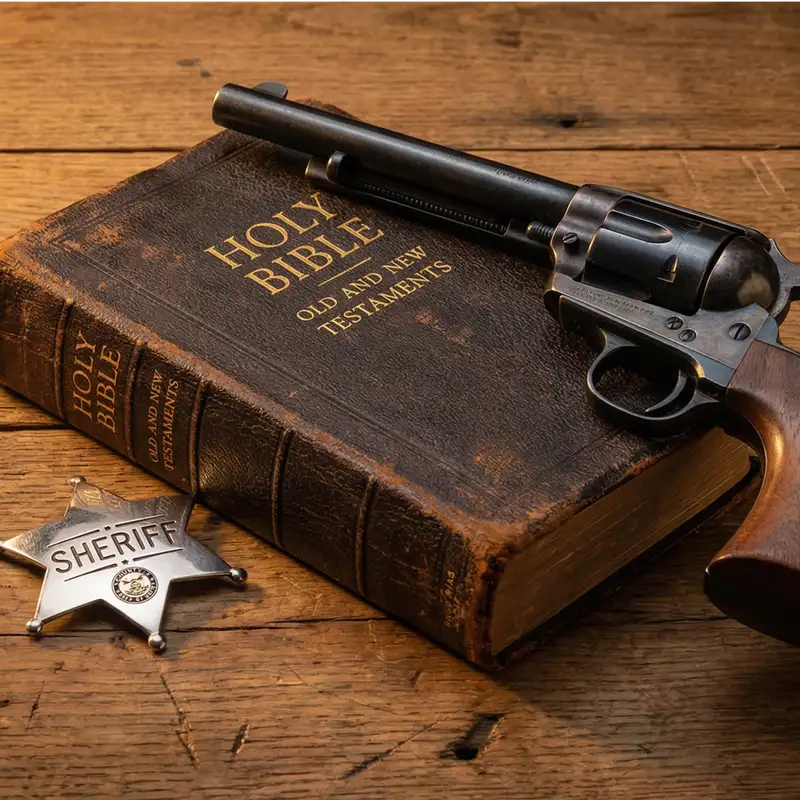
WTBL — Faith and the Badge
WTBL Walking The Blue Line (00:11)
Hey, welcome everyone back to another episode of Walking the Blue Line. Hi. So today we're going to talk about faith and the badge and more specifically how you can answer or how you've answered two different callings, serving God and serving the community. Yeah. Well, I guess from my point of view, it really is one in the same, I think the golden rule doing the
others as you would like to have them do unto you or love thy neighbor. all kind of melts into serving your community. And I think that that's what police work is all about. Yeah, well, it is a little I think it's kind of hard to carry a Bible and badge. like you said, it can blend together. There are.
different times when it can be very difficult in today's secular society where a lot of people don't want to hear about faith and such. But I still think that by serving our fellow man, we are following what we are told to do in the Bible. So I don't see that they're too far apart. I have a few questions here.
how does faith guide your split second decisions? Like, does that come into play? You know, split second decisions probably a lot of time come down to your training and your abilities, the things that you've been taught. But we do learn a lot through the Bible and our compassion and such.
I would not say that Bible verses flash into my mind or something like that when you're trying to make a split second decision. But you're always looking for the right thing to do. What's the best thing to do? And I've looked to faith to guide me through most everything in life. And so I have prayed ahead of time, for wisdom in those times when you have to make those split second decisions.
Yeah, prayer's a good thing. Right, it is. talking about prayer, doesn't that help you handle the stress and the trauma of, I mean, sometimes you guys have really hard days. We do. And unfortunately, some people will turn to other means to regulate their stress and not always good means such as alcohol or things like that. But overall, I think that
prayer and that relationship with God and looking to Jesus for the answers is the thing to do. so by having that relationship, it definitely helps deal with the day-to-day stresses and especially those highly critical incidents. Yeah, I know I pray a lot all the time, all day long. It's kind of like talking to your best friend, only you're talking to God. Right.
find myself, you know, probably praying for others way more than I do pray for myself, but I do pray for wisdom and the guiding hand to take me through those tough times. on our podcast before we've kind of hit on why you've become a police officer. but do you want to reiterate that or? Well, yeah.
We talked about the fact that it felt like a calling and I think that when you're in God's words a lot of people have a calling for life. So not everyone is meant to be a pastor, a preacher, But that doesn't mean that faith doesn't have a central role and to answer a calling to help our communities, help society, to...
look out for the victims. I think we're all kind of roles as to what led in my decision to become a police officer and have a role in law enforcement. So you would say it's kind of a, like you said earlier, you blend them together, a public service and a spiritual responsibility as you're trying to help these people or? Right. I don't believe
My faith, I don't believe that we get to heaven by doing good works, but that doesn't mean that good works are not encouraged. They are definitely encouraged throughout the Bible to do good things and by serving our community, I think that those are some of the good works that we can do. I agree. going back to the faith in the field, what about when it comes to use of force?
We have policies and procedures that are separate from your faith and belief. But I think that they align in the fact that when you are a police officer, what you're trained to do is use the minimal amount of force to accomplish the task. That means that you don't just go pummel people and beat them up because you have a badge. If you have someone that wants to fight with you or...
wants to disobey a lawful order and you have a reason that you have to use force to get them to comply, then you're gonna try to use the minimum amount. Unfortunately, in law enforcement, sometimes that minimum amount is actually lethal. Your firearm or some type of a defensive move that could be deadly. But at the same time, when it isn't called for,
You're just going to use the minimum amount and you're trying to do this in a compassionate manner so that you don't hurt anyone beyond what is necessary. Right. Well, I know when Dallace was working at the jail, she said that it was a really helpful tool to learn how to deescalate people. I remember a couple of times when she said the people that she was working with weren't
really into it one evening and she was like, know, if we just like kind of baby this person along and we'll get through this process a lot quicker than just being, upfront and forceful. Yeah, definitely. Every one of us are human when it comes to police officers, law enforcement, corrections officers, and we do reach our limit. there are times where
emotions are going to take a hold and sometimes override what you know to be the correct thing to do at the moment. But by and large, those de-escalation skills are gifts that God has given to us, so that we don't have to always be confrontational and forceful and use physical means. I think when it comes to
various agencies out there and what different officers are taught. We used to talk about it between the city and the county. The county would show up to a call with two officers where the city would sometimes have way more officers. They would show up with six to handle the same identical call. Well, those two deputies really need to learn de-escalation techniques and how to talk to people and how to be compassionate when you're handling a tough situation.
Sometimes balancing act exactly the city officers didn't always have to learn that they've got more people and they can handle the situation a little easier, right? They can just force a person to do whatever they need to and that's not necessarily Always bad, but by and large you want to treat people as well as they will let you right? That's what it really comes down to is the suspects kind of set the tone majority of the time as to
How is this going to play out? You need to learn to treat people with dignity, but also you have to be mindful of your own safety. don't think sometimes people understand when you guys make decisions, it's not as easy when you're out there and maybe you don't have as many people as backup. Yeah, when you're dealing with those kinds of situations, like a police officer will...
follow someone and they'll decide, hey, I'm gonna try to pull them over in this location, because that might be the safest location. But the minute they get out of their police vehicle and start walking up, everything really is, to some degree, controlled by the person that's sitting in that driver's seat. Because if they are a bad guy and they do mean harm to the officer...
They already know what they're going to do. They know that they're going to pull a firearm or that they're going to just step on the gas and drive away, or they're going to try to run this officer over. So all of those things, an officer has to respond to as a reaction instead of an action. And it really is in the suspect's decision-making on which direction is this going to go. So it is that training and it is that faith.
in God that they're watching over you and are going to help you through this that gets an officer through each one of those. Well, speaking of that, there's quite the darkness that you guys face. there's a lot of evil out there. There's a lot of trauma. So how do you feel about your exposure to the violence and the tragedy that you guys see? you've spoken to me a little bit about it.
You don't speak a lot about it, but you've been to S.I.D.s death. You've been to child abuse, domestic abuse, even adults. Yeah. Well, I've certainly feel that I've seen the worst of the worst in terms of some of the homicides that we get. The fact that these terrible scenes, again, I think you can retreat within your own faith that
there was a plan beyond your own knowledge that led into this. And it could be just evil is at work or something, but what I'm there to do is to help the victims. provided that they're not a homicide victim, I am going to do whatever I can to see that some kind of justice comes their way. And...
in the event of a homicide victim, then you were working for their family and trying to make sure that this death wasn't completely in vain. So your faith helps you get through that. I know a lot of times you guys maybe don't talk to people about faith if they definitely are like not wanting to be approached that way,
At the same time, I've been amazed over the number of years that I've done this, how many people are open to that? Is there worse possible times? You you show up at a traffic accident where someone riding in the same vehicle is now deceased and the surviving member has to move forward. And so sometimes having the comfort of someone that talks to them about a better place and, and God's role in this.
is welcoming to them. And I was also surprised when I very first came on the Sheriff's Office, that they had a chaplaincy program. So each time that we would go to a SIDS death or some type of a death, we could always ask those people, hey, would you like to speak with a chaplain? And quite often they would, if they weren't actively involved in their own church where someone from their own church was going to come over.
They would take us up on that and we would call one of the sheriff's department chaplains and they would come out and minister to them and try to be there with them and help guide them through some of the rough times. I think it was a nice idea to have a chaplain. because sometimes that's when people need them the most. You're going through a horrific situation and to have someone that's readily available.
Well, and with you guys' jobs too though, you handle it differently. Some people are quiet about it. Some people are suck it up, don't talk about it. Other people, no, I need to talk about this. our daughter and her husband are kind of going through a little bit of that right now where her husband is just all about the job. That's all he wants to talk about. That's all he really wants to do. And she's like, I want to work and I want to do my job. But when I come home, I don't want to think about it.
And it's just her way of decompressing or... Everyone has a different way of decompressing. And when I started back in the eighties, know, the chaplaincy was there. A lot of what they served were the people out in the community, but they were also there for the officers if they needed them. But not many officers would take it up. Over the 40 years almost that I've been...
active in law enforcement, we've seen a dramatic shift where there's usually a chaplaincy program with most departments out there, especially if they're of any size. But even when you don't have that, you'll have a peer team which allows the officer, somebody to go to and talk about the difficult things that they've had to deal with and help them mentally navigate.
all of the bad things that they're seeing and going through. Well, and there is also a protocol when someone's involved in a shooting specifically or something like that, those officers have to, what is it, one to two days that they need to take to, get their thoughts in order. I it's a lot to process and you're hit at it, you know, really quickly. Yeah, I know there's a segment of
society out there that believes that police go out and they're just looking for the person that they can shoot, but that really isn't it. That is the very last thing that anyone wants to do is have to take somebody else's life. And so when they get into these, officer involved shootings and, lethal encounters, then yeah, the agency will obviously put them.
administrative leave number one because there's gonna be an investigation into what led up to this but number two is you have to make sure that there's some mental stability and An officer has to be cleared before they come back to work yeah You don't want someone who just been through that kind of situation and just boom go right back to work because you just don't know where they're at Right and it wasn't always that way in the old days by you know, yeah, you know, so a lot has changed
At the same time, there's more stringent controls on officers in terms of, dealing with those kinds of situations. I think the body cams play into a part of that. right now, every single deputy out there has a body cam they're being watched almost all of the time. And obviously if they've done something wrong, it's most likely going to catch up with them,
it can also work to their benefit though where they can, well this happened. So obviously this was the correct response. Exactly. It isn't all just for bad stuff either. No, it's not. I think as humans, we oftentimes have a way of going to the worst place in our mind, like what's going to happen to me or that kind of thing. What are they going to see when they review this?
So there's a little bit of extra pressure that's added on the officers in that regard of watching these videos. Yeah, you think of your average person walking through their day, everything being filmed. You don't realize how often you might not judge a situation right or act correctly, There's nobody watching you 24 hours a day, at least when you're on your job.
Well, and even going down that road, just a little bit in terms of the filming, you and I have been doing this podcast for a short amount of time now, a few months, and it is amazing the things that you do on camera that you're not even aware that you're doing. the things you say. Right. So I'm sure there's a lot of editing, like filler words. But what's kind of funny about that is it more frequently catches the
people that are complaining as to doing bad things than it does the officer. it's amazing the number of complaints against officers that end up being dropped or such when the... Play the body cam back. Suspect sees the body cam and is like, oh did I... I didn't do that. Well, you did right there. it works good. It works both ways. So this...
is kind of leads into also how do you balance your job with your family? as to be upfront, we've struggled with this a bit as our own marriage. In the beginning, you were not like a newbie, but you'd only been on what, five, six years? not that it's not exciting, but you were really into your job and...
But later when there was three children at home and I'm there and you never seemed to not want to work. Well, yes, in fairness, I was a bit of a workaholic because I was always working at the sheriff's office. It's a 40 hour a week job and then typically there would be... Minimally it's 40 hours a week. Yeah, there would be, you know, five, six, maybe 10 hours overtime a week with that.
And on top of that, I was flying in the Air National Guard, which I had to go fly at least once a week and I would do a weekend guard drill and do deployments. And then on top of that, sometimes I was teaching or I was doing off duty work. Our entire marriage up until you retired, you were working two, three, sometimes four jobs. At a time.
Yeah. I think that based on personality, different people have different ways of looking at, what is it that you're trying to accomplish? And I think I justified mine on basically, I'm trying to provide a better lifestyle, more money, be able to do things. Whereas we talked about
the love languages before, I don't think that was your love language. It would have been quality time. mine definitely was quality time. so I've struggled most of my life with that's what I wanted to do. I want to spend time with people. I want to go do fun things. And so getting into a relationship with someone who was a workaholic and even your whole most of your family were workaholics. It was hard for me, especially
⁓ come holidays and stuff where I'm like, no, we make a big dinner and cookies and we have the family over and we have this awesome quality time. And you're like, yeah, no, I'm going to go work overtime. I'm like, what? No, you're not. No. Yeah. We argued about that a lot. But like you said, I mean, that was the way of my family. My dad was always one that worked seven days a week. And your sister and my sister. And she raised her children that way.
And they all worked shift work. think I look back on when I was a young kid growing up in a small town in Montana, they closed the town down on Sundays and everybody went to church, and. Not too different in the South. We had blue laws. Right. For a long time. I recall even when I very first moved to the Spokane area, I lived in Coeur d'Alene, Idaho was that there were some of the blue laws still left over.
And I forget which way it was. You either couldn't buy beer on Sunday or maybe you couldn't buy hard alcohol. Well, and where I lived, it was actually a dry County. You couldn't buy anything. You had to go across the County line to the state line to buy alcohol. Actually that was all the time. The blue laws were more like for Walmart and stuff like that. They just weren't open on Sunday. Yeah. So
going from a societal time when a lot of stores weren't open on Sunday to living in a bigger city where now everything was open and you're expected to work all the time. Yeah. And then I guess that was where I was going with that was people had nine to five jobs back then and they had weekends off and there wasn't all of this where you now work for an employer who
Basically expect you to be available any time of the day or night because that's the way society's moving. I definitely think for a marriage and a family Some advice there has to be some boundaries working is great and and doing your job. Well is great But there needs to be boundaries as far as okay. This is family time. This is when I'm
gonna work the supporting of the family, the husband supporting the wife and whether the wife works or not, I worked up until we had three of them at home, three children at home and I decided to stay home but for one, the childcare was so expensive. I enjoyed being home with them but it is a lot when it's just you.
doing it all by yourself. it is. I was very thankful that you were able to stay home. Although to some degree, sometimes I think maybe I worked a little bit harder because of that. we weren't a two income family, either way we kind of fluctuated. I think
in various times of our life about whether we had the quality time or not. know, we ended up buying a lot of toys like the boats and the motor home and motorcycles and that allowed us to get away occasionally. But on a very weekly basis, day to day, probably wasn't nearly at home as much as you would have liked. That's for sure.
For sure So well, so back to the question though what advice the advice would be, make sure that you're making that time to Definitely boundaries and and make time for each other because we I don't know if we've spoken about this earlier we used to have quite a few friends that were married and Unfortunately, we're one of the few couples that made it through that because exactly
several of our friends didn't make it, they ended up getting divorced. And the divorce rate for police officers and deputies is really high. Yeah, law enforcement and firefighters, first responders definitely have a high ⁓ rate of divorce. But to add on to that, make sure you make time, make sure you make time to get into the Word and that you're having time to spend with your relationship with God.
Keeping faith strong in the home and when you leave, when in your job, I think it helps a lot because if you don't have that faith, I just it's a lot easier to fall apart. is. Yeah, definitely. So let's go on to the tension between enforcing the law and trying to show grace to people that are breaking the law.
There's a lot of different ways that you can look at the people that you're going to encounter. Some of them are just evil. But a majority of people are no different than you. They have messed up. The Bible especially talks about everyone has fallen short and that we're all sinners. for the most part, that is what a lot of people that commit crimes are. I don't think on...
daily basis, people, set out to get a DUI. Nobody wants to get one of those. Nobody wants to get a ticket. Nobody wants to a ticket. Just speeding or going through a light or something. Yeah. Right. I have to say there wasn't as much emphasis maybe put on it when I very first joined the police department.
We always had a program and I think a lot of them are still true today, even in the days of Lyft and Uber, especially in the smaller towns is if you were drunk and you needed a ride home, they would work to facilitate that for you. home without you driving. Right. And I gave a number of people rides home without ever arresting them or giving them a ticket or anything to that matter.
Even with our ride alongs, when we would do traffic stops I don't know if I can even remember you writing a ticket you would pull people over and say hey do you need a ride home or your taillights out or something like that? I don't remember you writing too many tickets now. I wasn't a huge ticket writer I was always looking for what I considered to be the more serious things but that daughter is like that she says that she doesn't like to write tickets, but
That doesn't mean there isn't a place for that. No, there's times when people are doing things wrong or they're gonna hurt somebody Yes, and So along that lines, the type of enforcement action that an officer takes there was probably more discretion Used or available to the officer back in the day that I was doing it nowadays they're Trying to push, you know a lot more
of you're on camera when you pull somebody over, you handle them, letter of the law kind of thing. But officers can still use their discretion on whether they arrest someone or give them a verbal warning or however they may find suitable to handle it. So it's like your role in their accountability Exactly. Cause people do have to.
realize you're gonna, have to be held accountable. Yeah. And that's both in God's eyes and in the law's eyes is that so when you're doing something that you obviously know is against. or. Yeah, is wrong. Whichever way you're looking at that, then, there are gonna be consequences. Sometimes people.
do escape those consequences because they're very sneaky but it usually ends up catching up with you somehow. True. So let's go on to advice to young officers, which I know we've had numerous conversations with Dallace and Drew, our daughter and her husband. I think building the correct moral compass is a good one. Right. But
And we can go back to that. But one I will say is that, Drew is kind of into that. He just lives and breathes to be a police officer right now or a deputy. Right. And my daughter Dallace, she's like, well, yeah, when I'm there at work, I am. That's what I focus on. But when I come home, she's the opposite. She doesn't want to talk about it. She doesn't want to live it. She's like, I need to get away from it and not think about it. Yeah. And I think that.
that's a good way to be. I believe that that was mostly how I was. I loved my job. I liked doing it, but I didn't feel like I needed to burden you or everyone else with the things that I saw or did throughout a typical day. And sometimes there were days that there was nothing exciting to talk about to begin with, There were a few other days where you did talk to me about it and I can remember going,
That's just messed up. I almost wished you hadn't told me, but I think my favorite, my favorite things to tell you though, were things that had to do with the dirty houses because you're a over the top cleaner. Everything has to be spotless and bleached beyond belief in order to be clean. I grew up. Yeah. And so I can't relax if I'm in a dirty, even messy.
environment. And so our house isn't messy sometimes. When I would go into a hoarder's house or I would go into a drug den where just the filth is beyond belief, then I guess I'd like to come home and poke the bear and say, Oh, you should have to see this house. Our house is great. And I'm like, no, it's not. clean the bathroom. But for the most part,
I didn't really say a whole lot because I didn't feel like it was appropriate, especially with little kids, to bring some of that stuff home and talk about it. It's like, don't need to deal with these adult world things yet. Yeah. So I do think keeping faith into it though, right? To help you get through some of the stuff. And if you've got faith and when you are out there dealing with these people, maybe it'll help you be a little bit more compassionate. Some people though,
I'm not saying you shouldn't be compassionate, but there is just pure evil out there sometimes and you need to learn how to balance that too. Exactly. there were times where, I would go arrest someone and we probably didn't speak more than two words while I'm taking them to the jail and I'm dropping them off because anything I have to say really isn't going to make an impact on them. They are the way they are.
There were other people that ⁓ it was, like I said, amazing the number of people, not only at tragic situations, some situations where they truly wanted to turn their life around. And they would talk to me about faith and God. We would sometimes pray together. I had people come up to me on the street and ask if they could say a prayer with me.
hoping that I'm doing fine. I should say that like some of the off duty jobs that I did, though I worked at a church providing security. yeah, a couple of them providing security and during high profile events like the big Easter celebration, our church, had a couple thousand people in attendance and they would ask myself as well as a number of other officers, to provide security.
We did that as a service. So keeping the faith and...
You also, well we're giving advice to the young people. We kind of got off there a little bit. learning how to not get burned out. And like I said in the beginning when we argued about you working all the time, you could sometimes get burned out. I remember my family would always say, Lyle's tired, his eyes are bloodshot, my family would always comment on that.
But at home, I would get burned out. It's like, get it. You're working really hard. You're bringing home a good paycheck. But I'm exhausted and I need some help too. You got to learn to balance work, children, family, and then through your faith to help you come to those balancing acts. Exactly. Yeah. You have to try to, well, when you talk about balancing, you have to try to make time for your family, your children, your wife.
as well as for God and a little bit of time for yourself, do some activity that helps you relieve that stress or some people that's going to the gym or maybe is playing a musical instrument or something along that lines. But trying to keep a balance of all of those things is very healthy and it should be encouraged for sure. Yeah. Because if you're the kind of person that can't do that, it's going to
be really hard in a family situation, I believe, unless you're both that way. yeah, you need to learn how to step away from it a little bit. So we've given advice, we've talked about justice and trying to deal with people with compassion, keeping your faith, in the balance of all of that.
So do you have any closing remarks or anything specifically that I haven't touched on I think that all of these things that we discussed are things that people realize as they mature. Some of the things that we discussed, I had heard...
As advice from other officers when I first came on in terms of like trying to keep the balance and trying to keep the faith and that, it kind of goes in one ear and out the other, think when you're young and then as you start to get older, perhaps you start seeing some of the wisdom in the things that they said. if I could go back and I were a young officer, I would probably just try to heed what some of those more experienced people said a little bit.
sooner in life and taking their advice might have made a number of areas of life a little bit easier. Well for myself too, when I was younger, I think I was a lot more emotional. You're young, you're experiencing things for the first time. I've had my faith since I was a little kid. started out in, you know, church, got saved when I was like five years old. My mom was a...
It's Sunday school teacher and in the choir. And so I grew up with it, but growing up with it and always doing the right thing isn't, always easy. So I find myself being more resentful that you're not here well, let's just balance it out. I think we both could have probably prevented some hurt feelings that way. Yeah, but we did get through it with God's help.
relying on our faith, relying on our family sometimes, it was a long road. And then I'd walk again if I could, well, we're coming up on 31 years. And I think that's something it's not 50, but it's getting there. So, well, hopefully you find something about today's message. That's a little bit uplifting.
in the fact that faith is something to be seriously considered and followed. if you don't currently participate in a church or something of that type, I would certainly encourage you to look into it, especially for the young officers out there. it's like... Sometimes you can get so wrapped up in the...
evil and just dealing with it and the adrenaline rush it is hard sometimes to slow down and go okay maybe I'm approaching this wrong. yeah or not necessarily approaching it wrong but just not necessarily having priorities in the right areas. Exactly.
We want you to go home every night, but your physical health is just as important as your mental health and your spiritual health. So put some time into them and make sure that you're taking care of yourself all the way around. Yeah, I know for myself, prayer is big and I don't pray for myself nearly.
as much as I do for my family and friends and the country and the world. I don't know how people do it without God. And if there's any way we could lead even just one person to lean that way, it would be awesome. Right. You know, every person out there matters very much. Yes. You count. You count. Yeah, exactly. And we want to see, like we said, everyone
live a happy healthy life and we pray for that each day. And if you do enjoy this or you're following us if you would like and subscribe share or comment even let us know what you think or how we're doing. We appreciate it we appreciate you so for everyone until next time we'll say God bless and goodbye till next time.
Creators and Guests